
Cost Zero in Design. Where’s the Value?
Hello:
Lately I keep seeing posts on social media about personal projects. Lots of designers are finally daring (after putting it on their resolutions list year after year) to build their portfolio and personal brand. A task that used to feel almost Herculean is no longer unusual. And it is not an isolated case: The Verge is already writing about the rise of the >indie web, and in the first half of 2026 the number of >new apps on the App Store doubled compared with last year. Something is changing.
It is hard not to connect this with the AI boom. The technical cost of making things has dropped, and we depend less on learning the tools to make them. Where we used to need After Effects for a short animation, or Figma skills to prototype a web interaction, we can now generate PoCs or assets from prompts. We can move much faster than before, but… does that mean what we make is better?
With so many more apps being published, you would expect people to be downloading many more of them. The data says otherwise: downloads grew >just 2%.
App Store, first half of 2025 and 2026 · Source: Sensor Tower via The New York Times
The same is happening on the web: more than ever, tools and personal sites now compete with articles from news outlets. Lately I keep seeing >coalition simulators and poll analyses for Spain’s general election on 29 November, explainer videos about current events made with Claude, and even sites that track delays on Madrid’s >commuter trains. But when you look at how much these sites matter, many of them get lost in an endlessly refreshed feed where nothing sticks. Not to mention that many of them are slop UI or, as Katie Dill put it in her great talk at the Lenny & Friends Summit, >zombie UI.
I will not unpack the idea here (the talk is right below), but you get it: UI and interaction are not these sites’ strong suit.
Another answer may lie in how the job market is moving. For that we have a recent report by >Lenny Rachitsky on job openings in tech. The numbers are interesting (or worrying, depending on how you look at them).
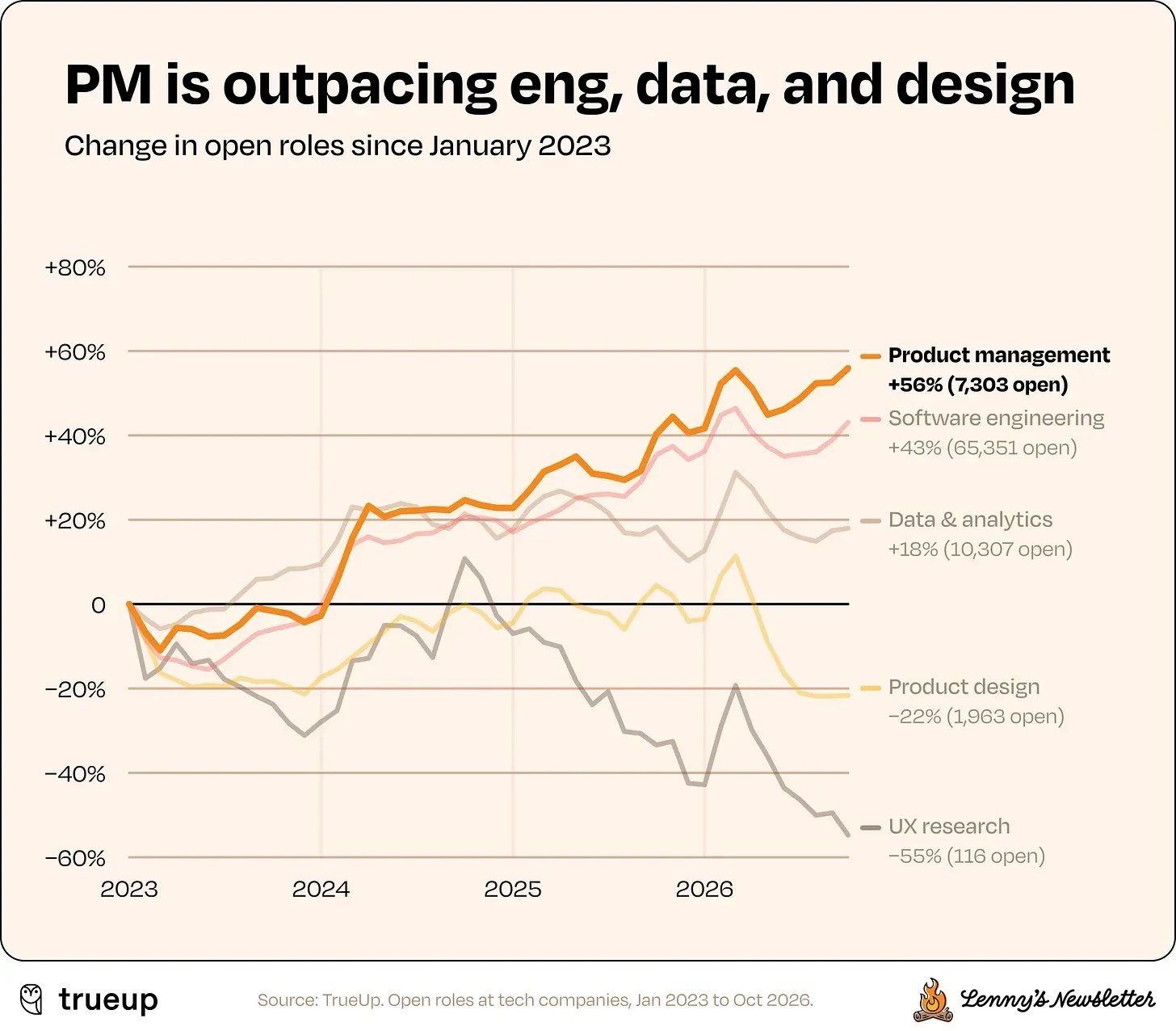
Since 2023, job openings for >Product Managers (PMs) have grown 56%. Meanwhile, over the same period, product design openings have fallen 22%, and UX research openings 55%. Seeing this, I was already looking at farms in Asturias where I could make >Gamonéu cheese and live my >locus amoenus without a care.
Does this mean product design is dead? Personally, I do not think so. Tech has always been volatile, even after years of >unstoppable growth (who has not heard their mum say “go into software engineering, there is always work there”? I certainly have), and often roles do not disappear, they just get >renamed. But there is another reading that strikes me more: the mistaken idea that, because a tool democratises access to design, we no longer need people who specialise in it.
You know I like nostalgia and looking back, so I would love you to watch this 1995 interview with Steve Jobs, from his >NeXT years after leaving Apple.
I recommend watching the whole thing, but at the minute I have marked, this is the line I keep: “… the disease of thinking that a really great idea is 90% of the work…”. Design decisions still take deep technical and craft knowledge. Design is not just making things fast; it is making them while knowing what not to make. It is understanding that a good idea almost never stays the same as it started. It gets cut, twisted, kneaded and left to rest, and in the end it never turns out the way we first imagined.
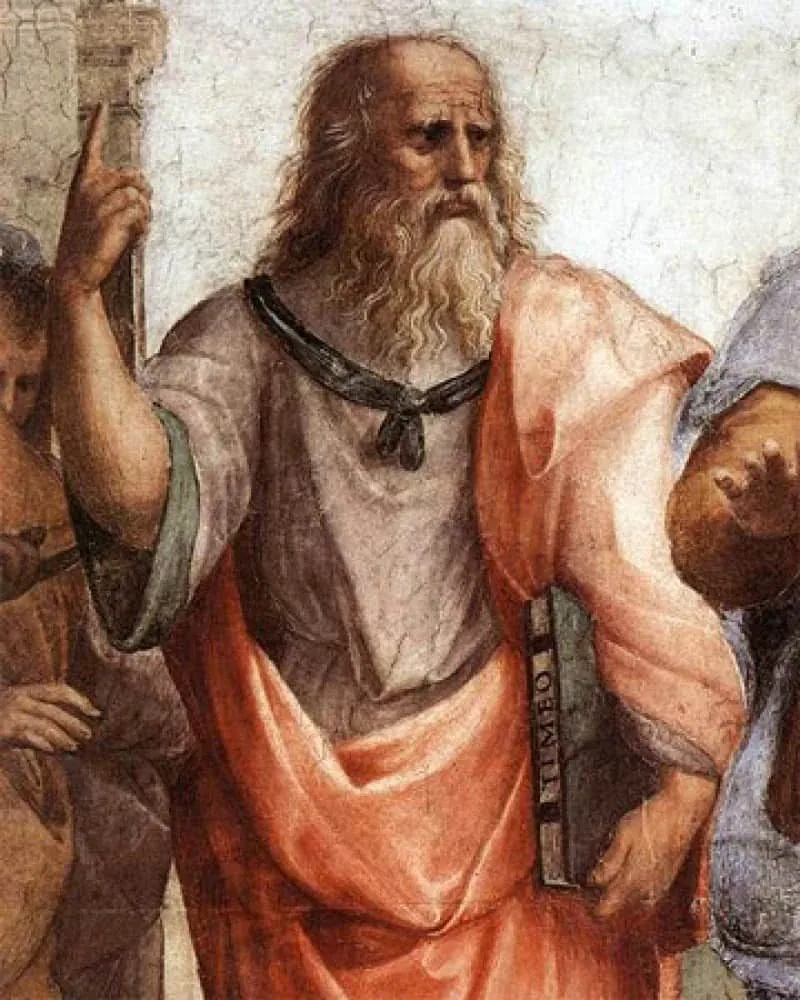
Plato, who may ring a bell, had a similar idea: we can never reach the >World of Forms; what we have is the >world of senses, where those ideas take shape, with all the limits of their own reality. Making something physically real is also an exercise in refining the idea, and often we will not be fully satisfied with the result.
Back to the question from the start, “So where does the value of design lie?”, it is time I gave you an answer. I do not have a universal one, but I do have mine. If making something barely costs anything anymore, the value cannot be in making it. It is in knowing why we make it. And for me, it is also in how every project helps me push past my limits and show a little better who I am. The tools have changed, and without them I probably could not do much of what I do today. But, above all, that “something” is still mine.
And that is the beautiful part: it is no longer about shutting ourselves inside our own borders, but about sharing our worlds.
Thank you for reading to the end. As will become a habit on DIEGOALO, here are my monthly recommendations, inspired by today’s topic:
FILM
Her — Spike Jonze (2013)
An intimate film about the power of connection. What makes Her interesting is that it does not try to impress by filling everything with screens: it imagines technology with sensitivity, made by hand with wood, paper and paint. Perfect evidence of the art of craft.
If you want to read more, there is a great interview with Geoff McFetridge, who designed the graphics, >here.
ALBUM
Soft — LANY (2025)
An intimate record built on the power of vulnerability, LANY’s Soft is a really interesting album, full of truth. I love sharing it today because it is about how our value does not depend on what we do, but on who we are.
My favourites are “Make Me Forget”, “Sound of Rain” and “When Did You Stop Loving Me?” (deluxe edition).
BOOK
The Goldfinch — Donna Tartt (2013)
Its protagonist, 13-year-old Theo, survives a bombing at a New York museum and, in the chaos, walks away with a small painting: Fabritius’s >The Goldfinch. The novel is his life around that painting.
CREATOR
 >PLAY
Today, without a doubt, I am sharing >@fakeplasticbrands. Marck is one of the most interesting people in my feed right now. The videos are packed with facts, references and trivia about art direction and how to develop your creativity. A must if you love endless inspiration, and those of you who know me know that I see art direction as a must-have for the designers of the future.
That is all for today. We will be back next month with more, unless I choke on the Christmas sweets first. You can send your thoughts to >[email protected], or reply to the newsletter email if you subscribe. And remember: subscribers get exclusive recommendations, like useful design tools and websites for inspiration.
ALO! in your inbox